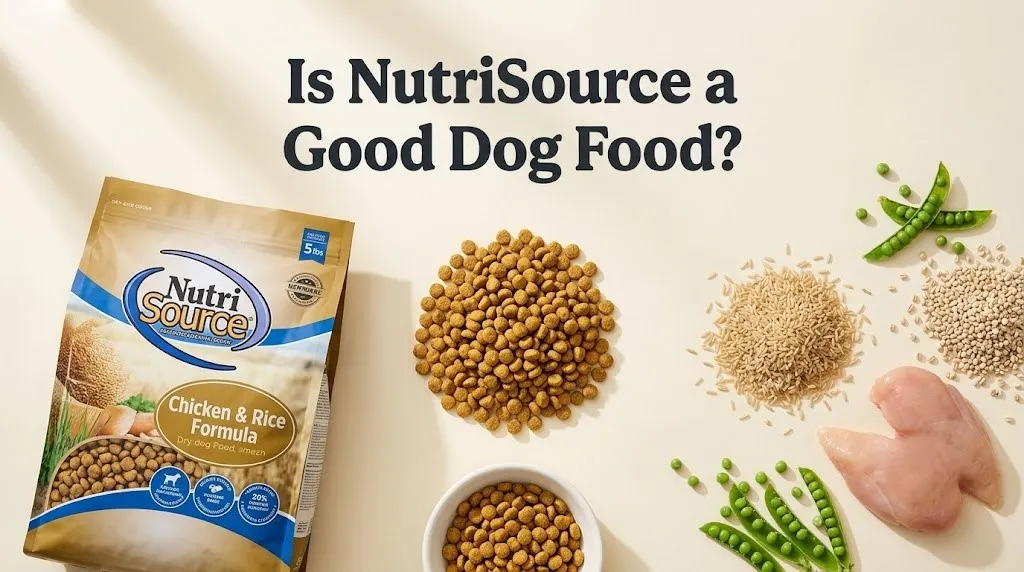
NutriSource is a good dog food brand that consistently meets the nutritional standards set by the Association of American Feed Control Officials (AAFCO) while using identifiable animal proteins as the first ingredient across most formulas. It earns its place in the solid mid-tier of the dog food market. It is not the most premium brand available and it is not a budget filler brand. It sits squarely in the range where quality ingredients, responsible manufacturing, and a fair price intersect.
Dog food is a YMYL purchase decision. The food you choose directly shapes your dog’s coat, digestion, energy level, and long-term organ function. NutriSource has built its reputation since 1964 as a family-owned company operating out of Perham, Minnesota, running its own manufacturing facility rather than outsourcing to a co-packer. That level of production control is unusual for a mid-sized brand and matters when ingredient sourcing and quality checks are on the line.
This review walks through the ingredient panel, the protein and fat levels across popular formulas, how NutriSource handles grain-inclusive and grain-free options, which dog profiles match best with the brand, and where it falls short compared to competitors. A veterinarian should always be part of your dog food decision, especially if your dog has kidney disease, pancreatitis, diabetes, or food allergies. Breed, age, activity level, and health status all affect what constitutes a good food for your specific dog.
Who Makes NutriSource and Where Is It Made?
NutriSource is manufactured by KLN Family Brands, a third-generation family-owned company headquartered in Perham, Minnesota. The company produces NutriSource dry kibble, canned food, and treats at its own SQF Level 3 certified facility in Perham. SQF stands for Safe Quality Food, a food safety management system benchmarked by the Global Food Safety Initiative (GFSI). Level 3 is the highest tier, indicating comprehensive food safety and quality management.
KLN also produces the brands Pure Vita, NutriSource Element Series, and Choice, each occupying a different price point in the pet food market. The shared manufacturing facility means that NutriSource benefits from the same quality control infrastructure as KLN’s higher-priced lines. The company’s Midwest location gives it proximity to agricultural supply chains for grains and animal proteins. That regional sourcing does not guarantee quality, but it shortens the distance raw ingredients travel before becoming kibble.
The family ownership structure matters in the pet food industry because it means the company answers to owners rather than quarterly shareholder reports. NutriSource has not been acquired by one of the large conglomerates that have consolidated much of the premium pet food market, such as Mars Petcare, Nestle Purina, or General Mills’ Blue Buffalo. Independent ownership allows a brand to prioritize ingredient decisions over margin targets, though it also means smaller marketing budgets and less retail shelf presence.
An SQF Level 3 certification indicates that the facility is audited annually for food safety plans, equipment maintenance, allergen control, and traceability systems. It is a credible third-party standard. Pet food manufacturing falls under FDA oversight through the Food Safety Modernization Act (FSMA), which requires preventive controls and current good manufacturing practices. NutriSource’s facility certification aligns with those federal requirements and adds an extra layer of external auditing.
Key Takeaway: NutriSource controls its own production in a top-tier certified facility, which is a genuine quality advantage over brands that contract out manufacturing to facilities with less transparency.
NutriSource Ingredient Analysis: What Is Actually in the Bag?
NutriSource builds its dry kibble formulas around named animal protein meals as the first ingredient, followed by whole grains or grain-free carbohydrate sources, chicken fat or other animal fats, and a proprietary probiotic and fiber blend. The ingredient panel reads like a mid-tier premium food: recognizable, mostly whole-food-derived, with some functional additives and a few plant-protein boosters that merit a closer look.
The first ingredient in the NutriSource Chicken and Rice Formula is chicken meal, a rendered and dried poultry protein that contains roughly 65 percent protein by weight. Before rendering, chicken is about 70 percent water. Chicken meal removes that water weight, so when it appears first on an ingredient list, it represents a higher protein contribution than fresh chicken would in the same position. This is ingredient panel literacy that matters when comparing brands.
Chicken fat appears as the primary fat source, preserved with mixed tocopherols (vitamin E compounds) rather than synthetic preservatives like BHA or BHT. Chicken fat is a species-appropriate animal fat that provides both palatability and linoleic acid, an essential omega-6 fatty acid for dogs. The fat is preserved with tocopherols, which are natural antioxidants. This is a point in the brand’s favor.
Ingredients that require context include pea protein, pea flour, and potato protein, which appear in the grain-free formulas. These concentrated plant proteins boost the guaranteed analysis protein percentage without being as bioavailable to dogs as animal protein. The Association of American Feed Control Officials (AAFCO) does not distinguish between animal and plant protein sources on the guaranteed analysis label, so a food can hit 30 percent crude protein while a meaningful portion of that protein comes from peas rather than chicken. Dogs can digest and use plant protein. They just digest animal protein more completely and derive a better amino acid profile from it.
- Primary ingredients in NutriSource Chicken and Rice: chicken meal, brown rice, barley, oatmeal, chicken fat, white rice, dried plain beet pulp, natural flavor, flax seed.
- Primary ingredients in NutriSource Grain-Free Chicken: chicken meal, chickpeas, peas, lentil beans, chicken fat, tapioca starch, pea protein, potato protein, dried plain beet pulp.
- Preservative system: naturally preserved with mixed tocopherols and citric acid.
- No artificial colors, flavors, or BHA/BHT across the entire NutriSource line.
NutriSource Nutritional Profile: Protein, Fat, Fiber, and Calories
NutriSource dry formulas deliver moderate to high protein, moderate fat, and a fiber level that reflects the brand’s focus on digestive health through its Good 4 Life supplement system. The macronutrient spread is appropriate for active adult dogs and performs well against other mid-tier brands. Puppies, pregnant or lactating females, and working dogs with higher caloric demands may need the higher-fat Element Series or more calorie-dense formulas from competitors.
| Formula (dry kibble, adult) | Crude Protein (min) | Crude Fat (min) | Crude Fiber (max) | Calories (kcal/cup, approx) |
|---|---|---|---|---|
| NutriSource Chicken and Rice | 26% | 16% | 5.5% | 380 |
| NutriSource Lamb Meal and Rice | 24% | 14% | 5.5% | 370 |
| NutriSource Grain-Free Chicken | 30% | 18% | 5.5% | 400 |
| NutriSource Element Series Coastal Plains | 32% | 18% | 4.5% | 410 |
| NutriSource Large Breed Chicken and Rice | 23% | 14% | 5.5% | 360 |
Data sourced from NutriSource product labels and brand-published nutritional information as of 2026
The protein levels are appropriate for the average pet dog. A 26 percent crude protein kibble supplies enough amino acids for maintenance in a healthy adult dog. The grain-free formulas push into the 30 to 32 percent range, which aligns with higher activity levels and supports lean muscle mass. The fat levels stay in the 14 to 18 percent range, which supports coat health and palatability without pushing caloric density too high for house pets.
The fiber content, consistently around 5 to 5.5 percent maximum crude fiber, is higher than many competitors. This reflects the inclusion of dried plain beet pulp, a soluble and insoluble fiber source that supports colonic health by providing fermentable substrate for beneficial gut bacteria. Beet pulp has been studied in canine nutrition and is recognized as a safe, effective fiber source. It is not a filler in the pejorative sense. It is a functional fiber ingredient.
Caloric density sits in the 360 to 410 kilocalories per cup range, which is standard for extruded dry kibble. For a 50-pound moderately active adult dog requiring roughly 1,000 to 1,200 calories per day, the feeding guidelines would recommend approximately 2.5 to 3 cups of NutriSource daily. Individual metabolic rate, activity, and body condition score should guide the actual portion, not the bag’s chart alone. A veterinarian can help calibrate this.
Is NutriSource Grain-Free Safe? The DCM Discussion in 2026
NutriSource grain-free formulas use chickpeas, peas, lentils, and potato protein as carbohydrate sources instead of grains. The safety question centers on whether these legume-heavy formulations are linked to dilated cardiomyopathy (DCM) in dogs, a topic the FDA has been investigating since 2018. As of 2026, the FDA has not established a causal link between grain-free diets and DCM, but the investigation has pushed the pet food industry toward reformulation and greater transparency.
The FDA’s investigation into canine DCM identified an association between grain-free diets high in peas, lentils, chickpeas, and potatoes and cases of DCM in breeds not genetically predisposed to the disease. The association does not equal causation. Nutritional researchers at Tufts University and the University of California, Davis have published studies suggesting that the formulation of grain-free diets, particularly the ratio and bioavailability of amino acids like taurine, may play a role. Legumes can alter taurine metabolism, and some dogs on legume-heavy diets have shown low taurine levels that improved with diet change and supplementation.
NutriSource has responded to this evolving science by maintaining its grain-inclusive lines as the core of the brand and including taurine in its formulations. The NutriSource Element Series includes added taurine, and the brand has emphasized that its grain-inclusive chicken and rice formula, the bestseller, has never been part of the DCM conversation. The company’s position is that grain-free is an option for dogs with grain allergies or intolerances confirmed by a veterinarian, not a default choice for all dogs.
The American Veterinary Medical Association (AVMA) and the World Small Animal Veterinary Association (WSAVA) recommend that dog owners select diets from brands that meet WSAVA nutritional guidelines and avoid boutique, exotic, or grain-free diets for dogs without a specific medical need. NutriSource is not a WSAVA-compliant brand in the sense that it does not employ a full-time board-certified veterinary nutritionist. That is a limitation worth acknowledging. Most mid-tier brands fall into the same category.
Quick Tip:
- If your dog is healthy with no confirmed grain allergy, choose a grain-inclusive NutriSource formula.
- If a grain-free diet is medically necessary, monitor your dog’s taurine levels with your veterinarian through blood work every 6 to 12 months.
- Watch for signs of DCM: lethargy, exercise intolerance, coughing, and difficulty breathing. Report concerns to your vet promptly.
Key Takeaway: NutriSource grain-free formulas use the same legume ingredients associated with the DCM conversation, so they should be chosen deliberately for dogs with specific grain sensitivities rather than as a general health upgrade. The grain-inclusive line is the safer default.
The Good 4 Life System: Probiotics, Prebiotics, and Digestive Health
The Good 4 Life system is NutriSource’s proprietary blend of probiotics, prebiotics, and trace minerals added to every formula. It is a brand signature feature and the most distinct nutritional claim NutriSource makes. The blend includes Lactobacillus acidophilus, Enterococcus faecium, and Saccharomyces cerevisiae as the live microbial components, plus dried chicory root and beet pulp as prebiotic fibers that feed the beneficial bacteria.
Probiotics in extruded kibble face a survival challenge. The extrusion process cooks the dough at high temperatures and pressures that kill live bacteria. NutriSource applies the probiotics after extrusion through a post-coating process, which protects them from the cooking heat. The company claims guaranteed levels of colony-forming units (CFUs) on the guaranteed analysis, which is a measurable standard. The stated minimum is 100 million CFU per pound of food. This is a moderate inclusion level compared to standalone probiotic supplements, which often deliver 1 to 5 billion CFU per serving, but it is enough to support maintenance of a healthy gut microbiome when fed daily.
Enterococcus faecium is a probiotic strain with a strong evidence base in canine nutrition. Research published in the Journal of Veterinary Internal Medicine has documented that certain E. faecium strains reduce the duration of acute diarrhea in dogs and improve fecal consistency. Saccharomyces cerevisiae is a yeast probiotic that competes with pathogenic bacteria for attachment sites in the gut lining. Lactobacillus acidophilus is a lactic acid bacterium that produces short-chain fatty acids during fermentation, lowering gut pH in a way that inhibits harmful bacteria.
The prebiotic portion of the Good 4 Life system includes inulin from chicory root and the soluble fibers in beet pulp. Inulin is a fructan that ferments in the colon and produces butyrate, a short-chain fatty acid that serves as the primary energy source for colonocytes, the cells lining the large intestine. This is a well-characterized nutritional mechanism. For dogs with sensitive stomachs or a history of loose stools, a food that includes prebiotics and post-extrusion probiotics may produce noticeably better stool quality.
NutriSource for Puppies, Seniors, and Specific Breeds
NutriSource offers life stage and breed size specific formulas that adjust protein, fat, calcium, and phosphorus to match the nutritional demands of growth, maintenance, and aging. The brand does not segment as aggressively as some premium competitors, but it covers the essential categories: puppy, large breed puppy, senior, small breed, and large breed adult.
NutriSource Puppy Chicken and Rice provides 28 percent protein and 18 percent fat, a nutrient density that supports rapid tissue growth and brain development. The formula includes docosahexaenoic acid (DHA), an omega-3 fatty acid critical for retinal and neural development in puppies. DHA is supplied through the chicken fat and any added fish meal or fish oil in the formula. The AAFCO Dog Food Nutrient Profiles require DHA in foods labeled for growth and reproduction, and NutriSource meets that standard.
NutriSource Large Breed Puppy adjusts the calcium and phosphorus levels downward compared to the standard puppy formula. Large and giant breed puppies, those expected to reach more than 70 pounds as adults, are susceptible to developmental orthopedic diseases like hip dysplasia and osteochondrosis if calcium intake is excessive during rapid growth. The American College of Veterinary Nutrition recommends that large breed puppy foods maintain a calcium-to-phosphorus ratio close to 1.2:1 and limit total calcium to no more than 4.5 grams per 1,000 kilocalories. NutriSource formulates its large breed puppy food with these constraints in mind, though the company does not publish the exact calcium gram amounts on the guaranteed analysis label.
NutriSource Senior Chicken and Rice drops protein slightly to 24 percent and fat to 12 percent, with added glucosamine and chondroitin for joint support. The lower fat content reduces caloric density to help prevent weight gain as metabolism slows with age. Senior dogs with kidney disease require protein restriction that is best managed with a prescription renal diet rather than a commercial senior formula. A veterinarian should guide that decision based on blood work, not age alone.
| Life Stage Formula | Protein (min) | Fat (min) | Key Nutrients Added |
|---|---|---|---|
| Puppy Chicken and Rice | 28% | 18% | DHA, calcium, phosphorus |
| Large Breed Puppy | 26% | 16% | Controlled calcium, phosphorus |
| Senior Chicken and Rice | 24% | 12% | Glucosamine, chondroitin |
| Small Breed Adult | 28% | 18% | Higher calorie density for metabolism |
NutriSource vs. Competitors: How It Compares to Blue Buffalo, Purina Pro Plan, and Hill’s
NutriSource competes in the mid-to-premium tier against Blue Buffalo, Purina Pro Plan, and Hill’s Science Diet. It beats Blue Buffalo on ingredient sourcing transparency and manufacturing control. It loses to Purina Pro Plan and Hill’s Science Diet on the presence of full-time board-certified veterinary nutritionists on staff and the volume of peer-reviewed research behind the formulas.
| Comparison Category | NutriSource | Blue Buffalo | Purina Pro Plan | Hill’s Science Diet |
|---|---|---|---|---|
| First Ingredient | Chicken meal | Deboned chicken | Chicken | Chicken |
| Manufacturing | Own facility, SQF Level 3 | Co-packed and own facilities | Nestle-owned facilities | Colgate-Palmolive facilities |
| Board-Certified Vet Nutritionist on Staff | No | No | Yes | Yes |
| WSAVA Compliant | No | No | Yes | Yes |
| Price (per lb, approximate) | $2.50 to $3.50 | $2.80 to $4.00 | $2.80 to $4.50 | $2.50 to $4.00 |
| Grain-Free Options | Yes | Yes | Yes | Limited |
| Probiotics Included | Yes (post-extrusion) | Yes (LifeSource Bits) | Yes (live probiotics) | Yes (prebiotic fiber focus) |
Purina Pro Plan and Hill’s Science Diet are the category leaders for a reason. Both employ multiple board-certified veterinary nutritionists. Both conduct lifetime feeding trials. Both are WSAVA compliant. Both have published research in peer-reviewed veterinary journals. These are the standards that define the scientific end of the pet food industry. NutriSource does not operate at that level. It operates at the level just below, where good ingredients, clean manufacturing, and functional additives like probiotics compete against the research-driven giants.
Blue Buffalo is the most direct comparison. Both are independent (Blue Buffalo was acquired by General Mills in 2018 but operates with some autonomy). Both market heavily on ingredient quality and the absence of by-product meals and artificial preservatives. NutriSource holds an edge in manufacturing control because it makes its own food. Blue Buffalo’s ingredient panel often leads with deboned chicken, which contains water weight and inflates the ingredient list ranking. Chicken meal as the first ingredient, NutriSource’s approach, is a more honest representation of the protein contribution.
Key Takeaway: NutriSource is a strong choice for pet owners who prioritize manufacturing transparency and digestive health support. Pet owners who want a brand backed by the most rigorous feeding trial research should look to Purina Pro Plan or Hill’s Science Diet.
NutriSource Recalls and Safety History
NutriSource has maintained a clean recall record with no FDA-mandated recalls as of 2026. This is an unusual and noteworthy record for a pet food company that has been in continuous production since 1964. A zero-recall history across more than 60 years does not mean the brand is flawless. It does mean the company’s quality control systems have successfully caught potential problems before they reached retail distribution.
Pet food recalls in the United States are reported through the FDA’s Recalls and Withdrawals database, which is publicly searchable. Recalls can be voluntary, initiated by the company, or mandatory, ordered by the FDA. Common reasons include Salmonella contamination, Listeria monocytogenes detection, elevated vitamin D levels, and foreign material contamination. The pet food industry has seen high-profile recalls from major brands including Hill’s Science Diet (elevated vitamin D, 2019), Purina (multiple recalls across product lines over decades), and Blue Buffalo (propylamine contamination, 2017).
A zero-recall history is a risk management indicator. It suggests that the company tests raw ingredients before they enter production, verifies finished product safety before release, and maintains equipment sanitation to a standard that prevents cross-contamination. The SQF Level 3 certification at the Perham facility supports this interpretation. It is a high bar for food safety management.
Pet owners should still monitor their dog’s response to any new food, including NutriSource. A single recall-free brand history does not guarantee a future without issues. Sudden changes in appetite, vomiting, diarrhea, or lethargy after starting a new bag of food, regardless of brand, warrant a call to the veterinarian. Keep the lot number and best-by date from the bag. Those details are essential for traceability if a problem does arise.
How to Transition Your Dog to NutriSource
A proper food transition takes 7 to 10 days and prevents the digestive upset that comes from sudden dietary change. Dogs have a population of gut bacteria adapted to their current food. Switching too quickly starves those bacteria and introduces new substrates before the microbiome can adjust. The result is diarrhea, gas, and a dog who looks miserable.
To transition your dog to NutriSource:
- Days 1 to 3: Feed 25 percent NutriSource mixed with 75 percent of the current food. Measure both accurately.
- Days 4 to 6: Feed 50 percent NutriSource mixed with 50 percent current food. Watch for loose stools or vomiting.
- Days 7 to 9: Feed 75 percent NutriSource mixed with 25 percent current food. Stool quality should stabilize by this point.
- Day 10: Feed 100 percent NutriSource at the recommended portion for your dog’s weight and activity level.
Dogs with sensitive stomachs, inflammatory bowel disease, or a history of food intolerance may need a longer transition of 14 to 21 days. Adding a probiotic supplement beyond what NutriSource already includes can provide additional gut support during the switch. FortiFlora by Purina and Proviable by Nutramax are widely available probiotic products used in veterinary practice. A veterinarian can recommend the right one for your dog’s situation.
If loose stool persists beyond the transition period, reduce the portion slightly. Overfeeding is a common cause of soft stools that gets misattributed to the food. If symptoms include vomiting, itching, ear inflammation, or paw licking, a food allergy or intolerance may be the cause. An elimination diet trial under veterinary supervision is the gold standard for diagnosing food allergies in dogs. Blood and saliva tests sold as allergy diagnostics are not validated for this purpose and the American College of Veterinary Dermatology does not recommend them.
Where to Buy NutriSource and What It Costs in 2026
NutriSource is sold through independent pet specialty retailers, regional chains, and online through select e-commerce platforms. It is not available at major big-box retailers like Walmart or Target, and it is not widely available on Amazon, which distinguishes it from brands like Blue Buffalo and Purina that have broad mass-market distribution.
The brand’s distribution strategy follows the independent pet store model. Stores like Pet Supplies Plus, Chuck and Don’s, Bentley’s Pet Stuff, and other regional independent chains carry NutriSource. The brand locator tool on the NutriSource website allows searching by ZIP code. Online retailers like Chewy and PetFlow carry the brand, though availability fluctuates by region and formula.
Pricing as of early 2026:
- NutriSource Chicken and Rice (30 lb bag): $55 to $70, approximately $1.83 to $2.33 per pound.
- NutriSource Grain-Free Chicken (26 lb bag): $65 to $80, approximately $2.50 to $3.08 per pound.
- NutriSource Element Series (25 lb bag): $70 to $85, approximately $2.80 to $3.40 per pound.
- NutriSource Canned Food (13 oz can, case of 12): $36 to $48, approximately $3.00 to $4.00 per can.
NutriSource is more expensive than grocery-store brands like Pedigree or Kibbles ‘n Bits and less expensive than premium boutique brands like Orijen or Acana. It sits at a price point comparable to Diamond Naturals, Taste of the Wild, and the lower end of the Blue Buffalo line. For a mid-tier brand with good manufacturing credentials and functional additives, the price is fair.
Automatic delivery through Chewy or PetFlow can reduce the per-bag cost by 5 to 10 percent if you subscribe to recurring shipments. Local independent retailers sometimes offer loyalty programs, buy 10 bags get one free, that bring the effective cost below online pricing. Pet food pricing is regionally variable in 2026, and calling your local store for a current shelf price is more reliable than any national estimate.
Key Takeaway: NutriSource costs about as much as other mid-tier premium foods. The price reflects solid ingredients and domestic manufacturing. It is neither a bargain buy nor an overpriced luxury label. For what is in the bag, the value proposition is reasonable.
Frequently Asked Questions About NutriSource Dog Food
Is NutriSource good for dogs with allergies?
NutriSource can work well for dogs with food allergies because the brand offers single-animal-protein formulas like lamb meal and rice or the grain-free Element Series with novel proteins like trout and turkey.
The limited ingredient options and absence of common fillers like corn, wheat, and soy reduce the number of potential allergens in the food.
Food allergies in dogs should be diagnosed through a veterinary-supervised elimination diet trial, not inferred from symptoms alone.
Does NutriSource cause DCM in dogs?
NutriSource has not been directly implicated in FDA DCM case reports, but its grain-free formulas use peas, lentils, and chickpeas, the same legume ingredients associated with the DCM investigation.
The FDA has not established causation between any specific brand or ingredient and DCM.
Choosing a grain-inclusive NutriSource formula eliminates the legume concern entirely for dogs without a confirmed grain allergy.
Is NutriSource better than Blue Buffalo?
NutriSource holds an advantage over Blue Buffalo in manufacturing control because it produces its own food in an SQF Level 3 certified facility.
Blue Buffalo uses co-packers for some product lines, which reduces quality oversight compared to in-house production.
NutriSource also leads with chicken meal rather than deboned chicken, making the protein contribution more transparent on the ingredient panel.
Can I feed NutriSource to my puppy?
NutriSource offers a dedicated puppy formula and a large breed puppy formula that meet AAFCO nutrient profiles for growth and reproduction.
The puppy food includes DHA for brain development and appropriate calcium levels for skeletal growth.
Large breed puppies should eat the large breed puppy formula specifically to reduce the risk of developmental orthopedic disease from excessive calcium intake.
Where can I buy NutriSource dog food?
NutriSource is available at independent pet specialty stores and regional chains like Pet Supplies Plus, Chuck and Don’s, and Bentley’s Pet Stuff.
It is also sold through online retailers like Chewy and PetFlow, though availability varies by location.
NutriSource is not sold at Walmart, Target, or Amazon as of 2026, which is a deliberate distribution strategy focused on independent retailers.
NutriSource is a good dog food from a company with real manufacturing control, a clean safety record, and a practical focus on digestive health that shows up in every formula. The grain-inclusive lines are the strongest choice for most dogs. The grain-free lines should be reserved for dogs with a veterinarian-confirmed grain intolerance, not picked off the shelf as a general upgrade.
The best way to evaluate any dog food is to watch your dog for six to eight weeks on it. Coat shine, stool consistency, energy level, and appetite tell you more than any ingredient panel or brand reputation. If your dog looks good, feels good, and produces firm stools on NutriSource, the food is working.
Bring the bag label to your next veterinary visit. Your vet knows your dog’s specific health profile, breed predispositions, and blood work trends. That individual knowledge combined with the information in this review is the right way to answer the only question that actually matters: is this food good for your dog.