
The most reliable way to make black icing with food coloring is to start with a brown base, typically chocolate buttercream or cocoa powder, then add black gel food coloring one drop at a time until the mixture reaches a deep charcoal that reads as black. Starting from white icing and adding black coloring alone requires so much dye that the icing turns bitter, thin, and unpleasant to eat long before it looks truly black.
Black is the most difficult food color to achieve with standard liquid dyes. The FDA regulates color additives in food, and the approved black food dyes are blends of Red 40, Blue 1, Yellow 5, and sometimes Blue 2, combined to absorb enough light across the visible spectrum that the human eye registers black. This is harder to pull off than it sounds. The concentration needed to overpower a bright white buttercream base often exceeds what is practical or palatable. Professional bakers have learned to work smarter by starting darker.
This guide covers every method that produces a genuine black icing: the chocolate base shortcut, the gel color build, activated charcoal and black cocoa options, and how to avoid the bitter taste and stained teeth that give black frosting a bad reputation. Each technique is rated by color quality, flavor impact, and ingredient accessibility as of 2026.
How Do You Make Black Icing With Food Coloring?
You make black icing with food coloring by starting with a brown frosting base, then mixing in black gel or paste food coloring in small increments until the icing darkens to a true black. The brown base does most of the work. The gel coloring finishes the job without flooding the icing with liquid.
Standard liquid food coloring from the grocery store is the weakest tool for this task. Liquid colors are water-based and thin. Adding enough drops to turn white buttercream black introduces tablespoons of excess liquid, which breaks the fat emulsion and produces a soupy, bitter mess. Gel food coloring, sold in small squeeze bottles or pots by brands like Wilton, Chefmaster, AmeriColor, and The Sugar Art, is concentrated and contains very little water. A few grams of gel color can shift an entire batch of dark brown icing to black without altering the texture.
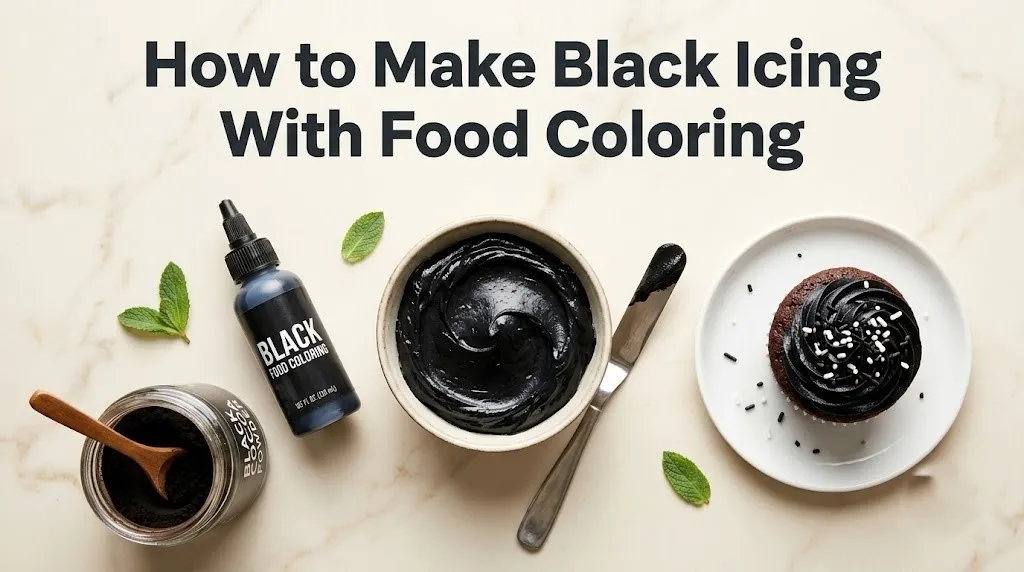
Powdered food coloring and oil-based candy colors are alternatives for specific applications. Powdered colors work well in dry mixes and chocolate but can leave a gritty texture in buttercream if not dissolved first. Oil-based colors are designed for high-fat systems like chocolate and candy melts. They will not mix evenly into a water-based royal icing. Matching the color type to the icing type prevents separation and streaking.
The process requires patience. Add the gel color in pea-sized amounts. Mix thoroughly after each addition. The color deepens as it sits. Icing that looks slightly lighter than black after mixing will often darken to a true black after 10 to 15 minutes of rest. Rushing this process by dumping in more color is the most common path to a bitter, gray, failed batch.
The Chocolate Base Method: The Easiest Way to Make Black Icing
Starting with chocolate buttercream or adding cocoa powder to vanilla icing is the single best shortcut to black frosting. The cocoa provides a deep brown foundation that requires a fraction of the black food coloring that a white base demands. The flavor benefit is just as important. Chocolate frosting naturally tastes like chocolate. Black food coloring added to chocolate tastes like darker chocolate. Black food coloring added to vanilla tastes like bitter chemicals.
Black cocoa powder is an even more powerful tool. Black cocoa is heavily Dutch-processed, meaning it has been treated with an alkalizing agent to neutralize acidity and darken the color. It is the cocoa used in Oreo cookies and it produces a nearly-black brown all by itself. Substituting black cocoa for one-third to one-half of the cocoa powder in a standard chocolate buttercream recipe yields a frosting that is already charcoal gray before any food coloring touches it. A few drops of black gel color finish the job.
The chocolate base method works for buttercream, cream cheese frosting, ganache, and even pourable glazes. For a standard buttercream batch that yields roughly 3 cups of finished frosting, add 1/3 cup of cocoa powder or 1/4 cup of black cocoa powder to the creamed butter and sugar mixture. The result is a dark brown frosting that reaches black with 1/2 to 1 teaspoon of black gel color. That is roughly one-tenth the amount of coloring a white base would need.
The flavor of chocolate-based black icing is the method’s strongest selling point. It tastes like chocolate cake frosting, because that is what it is. There is no metallic aftertaste, no stained teeth, and no tongue discoloration. For a child’s birthday cake, a Halloween party, or any event where people actually want to enjoy eating the frosting, the chocolate base method wins on both color quality and taste.
| Method | Starting Color | Black Gel Needed (per 3 cups icing) | Flavor Impact | Best Use |
|---|---|---|---|---|
| White buttercream base | White | 2 to 3 tablespoons | Bitter, chemical | Not recommended |
| Chocolate buttercream base | Medium brown | 1/2 to 1 teaspoon | Chocolate, slight bitterness | Buttercream cakes, cupcakes |
| Black cocoa base | Charcoal gray | 1/4 to 1/2 teaspoon | Rich chocolate, no bitterness | Any chocolate-compatible dessert |
| Activated charcoal base | Pale gray | None to 1/4 teaspoon | Neutral, slightly earthy | Vegan, no-dye applications |
| Royal icing with gel color | White | 1 to 2 teaspoons | Bitter, almond extract helps mask | Cookie decorating |
Key Takeaway: Use chocolate buttercream or black cocoa as your base. The color work is easier, the flavor is better, and you will use a tiny fraction of the food coloring compared to starting with white icing.
Gel vs. Liquid Food Coloring for Black Icing
Gel food coloring is the only practical choice for making black icing. Liquid food coloring is too weak, too watery, and too likely to break the emulsion of a buttercream or royal icing before enough pigment has been added. This is not a matter of preference. It is a matter of food chemistry.
A standard bottle of liquid black food coloring contains roughly 1 fluid ounce of water, propylene glycol, and dissolved synthetic dyes. Adding even 1 tablespoon of this liquid to a buttercream introduces enough water to start separating the fat from the sugar. Buttercream is a water-in-fat emulsion. The small amount of liquid from vanilla extract and milk or cream is already near the limit of what the emulsion can hold before it splits. Adding dye liquid on top of that pushes the system past its breaking point.
Gel food coloring from Chefmaster, AmeriColor, and Wilton uses a gum base, typically xanthan gum or gum arabic, to suspend the dye particles in a thick, low-moisture paste. The water activity is low enough that a teaspoon of gel adds negligible liquid to a batch of icing. The pigment concentration is significantly higher. A pea-sized squeeze of AmeriColor Super Black gel delivers more coloring power than an entire bottle of liquid black dye.
Powdered food coloring is an option for royal icing and fondant where any added moisture matters. Powdered colors are pure pigment and carrier solids with zero water. They disperse best when mixed into a small amount of the icing first to form a paste, then blended into the full batch. The downside is that powders are harder to find in retail stores as of 2026 and tend to be sold in larger quantities aimed at professional bakers.
Oil-based candy colors are the correct choice for tinting melted white chocolate, candy melts, or modeling chocolate. Water-based gel colors will cause melted chocolate to seize, the sugar and cocoa solids clump into a grainy, unworkable mass. Oil-based colors blend smoothly into cocoa butter and stay emulsified. For chocolate work, match the color type to the fat system or the project will fail before it begins.
How to Make Black Icing Without Cocoa
Black icing without cocoa is possible using activated charcoal powder, black sesame paste, or a dedicated multi-day color development process that starts with royal icing tinted to the maximum gel color concentration. None of these methods taste as good as the chocolate base approach. They exist for situations where chocolate flavor is incompatible with the dessert, like a lemon cake or a vanilla cookie.
Activated charcoal powder is a black, flavorless powder made from carbonized coconut shells, bamboo, or wood. It produces a deep, flat black with no red or purple undertones. The color is genuinely impressive. The catch is that activated charcoal can interfere with the absorption of medications in the human digestive tract. The Mayo Clinic and other medical authorities warn that activated charcoal binds to drugs including antidepressants, heart medications, and birth control pills, reducing their effectiveness. For a decorative cake eaten in small servings by healthy adults, the risk is low. For a child’s birthday cake or anyone on prescription medication, activated charcoal icing is a conversation to have with a pharmacist, not just a recipe decision. The FDA has not approved activated charcoal as a food color additive, though it is permitted as a colorant in other countries and is widely available in the U.S. as a dietary supplement.
Black sesame paste or black tahini adds a nutty, slightly bitter, roasted flavor to buttercream and turns it a natural charcoal gray. The paste is made from ground unhulled black sesame seeds and is used in Japanese and Chinese desserts. It will not produce a jet black on its own. Combined with a small amount of black gel color, it creates a deep black with a flavor profile that works beautifully with honey, matcha, or dark chocolate cakes.
Royal icing can be tinted to a deep charcoal gray that reads as black through a technique used by competitive cookie decorators. Make a stiff royal icing with extra powdered sugar to reduce the water content. Add black gel color until the icing is dark gray. Cover and let it sit at room temperature for 12 to 24 hours. The color deepens as the dyes oxidize and the icing matures. This method requires planning ahead and the final color is never quite as black as the cocoa method, but it is the best available option for vanilla-flavored cookie icing.
Step-by-Step: Black Buttercream Frosting Recipe
This recipe produces a true black chocolate buttercream with a rich fudge flavor and zero chemical aftertaste. The yield is enough to frost a two-layer 8-inch cake or 24 cupcakes. The skill level is moderate, requiring an electric mixer and patience with the color development.
Yield: Approximately 3 cups
Prep time: 20 minutes
Equipment: Stand mixer or hand mixer, mixing bowl, spatula
Ingredients:
- 1 cup (227 g) unsalted butter, room temperature
- 3 cups (360 g) powdered sugar, sifted
- 1/2 cup (50 g) black cocoa powder, sifted (or substitute 1/3 cup standard Dutch-processed cocoa plus 2 tablespoons extra)
- 3 to 4 tablespoons whole milk or heavy cream, room temperature
- 2 teaspoons vanilla extract
- 1/4 teaspoon fine sea salt
- 3/4 to 1 1/2 teaspoons black gel food coloring (Chefmaster Super Black or AmeriColor Super Black)
Method:
- Place the room-temperature butter in the bowl of a stand mixer fitted with the paddle attachment. Beat on medium speed for 3 minutes until pale, fluffy, and doubled in volume.
- Stop the mixer. Add the sifted powdered sugar, black cocoa powder, salt, and vanilla extract. Drape a kitchen towel over the mixer to contain the sugar dust and mix on low speed for 30 seconds until the dry ingredients are partially incorporated.
- Add 3 tablespoons of milk. Increase speed to medium and beat for 2 minutes. The mixture should be thick, smooth, and uniformly dark brown.
- Scrape down the bowl. Add 1/2 teaspoon of black gel food coloring. Beat on medium for 30 seconds. Assess the color. The frosting will be dark charcoal at this point.
- Add another 1/4 to 1/2 teaspoon of gel color. Beat for 30 seconds. The frosting should now read as black against a white spatula.
- If the color needs more depth, add the final 1/4 to 1/2 teaspoon. Beat for 30 seconds. Check the flavor. If bitterness is present, beat in 1 additional tablespoon of powdered sugar.
- Let the frosting rest for 10 minutes before using. The color will deepen as it sits. Frost the cake and serve. The frosting holds at room temperature for 1 day or refrigerated for up to 5 days.
Nutrition per serving (2 tablespoons, approximately): 175 calories, 10 g total fat, 6 g saturated fat, 24 g carbohydrates, 18 g sugar, 1 g protein.
The technique note that matters most: room temperature butter. Cold butter will not aerate properly, and the resulting buttercream will be dense and streaky rather than light and smooth. If your butter is cold, cut it into cubes and let it sit on the counter for 30 minutes. It should yield to a finger press but still hold its shape.
How to Make Black Royal Icing for Cookies
Black royal icing requires a slightly thicker consistency than standard decorating icing and a rest period for the color to mature. Royal icing is a mixture of pasteurized egg whites or meringue powder, powdered sugar, and water. It dries to a hard, matte finish and is the standard medium for decorated sugar cookies.
To make black royal icing:
- In a stand mixer bowl, combine 4 tablespoons of meringue powder and 1/2 cup of lukewarm water. Whisk by hand until frothy.
- Add 1 pound (approximately 4 cups) of sifted powdered sugar and 1 teaspoon of vanilla extract or clear vanilla for a brighter white base.
- Mix on low speed until combined, then increase to medium and beat for 4 to 5 minutes until the icing forms stiff, glossy peaks.
- Transfer one-third of the icing to a separate bowl for black coloring. The remainder can be tinted other colors or left white.
- Add black gel food coloring 1/4 teaspoon at a time. Mix thoroughly after each addition. Stop when the icing is dark charcoal gray.
- Thin the black icing with water, one drop at a time, until it reaches a 15-second flood consistency: a ribbon of icing dripped from the spatula settles back into the surface in 15 seconds.
- Cover the bowl tightly with plastic wrap pressed against the icing surface. Let it rest for 6 to 12 hours. The color will deepen to a darker black during this rest.
- Stir gently before using to knock out any air bubbles. Decorate cookies and allow to dry at room temperature for 12 to 24 hours.
The extended rest is the step that most home bakers skip. Royal icing darkens as the water evaporates and the dyes concentrate further. Icing that looks disappointingly gray at midnight can be a respectable black by morning. Patience replaces food coloring volume.
Food safety note: Royal icing made with meringue powder is shelf-stable and does not require refrigeration. The low water activity of the dried icing inhibits bacterial growth. The USDA considers meringue powder a safe alternative to raw egg whites for uncooked applications because the egg whites in the powder have been pasteurized and dried.
Natural Alternatives to Black Food Coloring
Natural black food coloring is the most challenging color to achieve without synthetic dyes because nature produces very few truly black pigments that are both edible and stable in food. The available options produce dark gray, deep purple, or charcoal tones rather than a true jet black. They work for home bakers who prioritize natural ingredients over a perfect color match.
Activated charcoal is the most effective natural blackener, producing a flat, true black with no other color undertones. As noted above, it has medication interaction risks that require attention. For a decorative cake served at a party where guests eat a single slice, the dose of charcoal in the icing is very small. The concern is for anyone taking daily medication who eats the icing regularly or in large quantity. A pharmacist can provide individualized guidance.
Black cocoa powder is a natural ingredient with no food coloring status at all. It is simply heavily alkalized cocoa. The dark color comes from the Maillard reaction products and the neutralized acidity shifting the cocoa’s natural red-brown into the near-black range. It is the safest, best-tasting, and most widely available natural blackening ingredient for frosting.
Squid ink and cuttlefish ink are used in savory cooking and pasta making but are not suitable for sweet frosting. The flavor is briny, oceanic, and deeply incompatible with sugar. Some specialty black gel colors marketed as “natural” use vegetable carbon, which is essentially activated charcoal derived from plant sources and carries the same medication-binding concerns.
Purple sweet potato powder and blueberry powder produce a deep purple that can be pushed toward black with the addition of black cocoa or a small amount of activated charcoal. The color is never a true black. It is a very dark aubergine. For a Halloween cake where a spooky, almost-black color is the goal, the purple-black look can be effective and remains fully natural.
| Natural Blackening Agent | True Color Result | Flavor Impact | Safety Notes |
|---|---|---|---|
| Black cocoa powder | Charcoal to near-black | Rich chocolate | Safe, no concerns |
| Activated charcoal | True black | Neutral | Binds medications, use with caution |
| Squid ink | True black | Briny, savory | Shellfish allergen, not for sweets |
| Vegetable carbon | True black | Neutral | Same medication concerns as charcoal |
| Purple sweet potato | Deep aubergine | Mild, sweet | Safe, natural food ingredient |
How to Avoid Bitter-Tasting Black Icing
Black icing turns bitter when the concentration of synthetic food dye exceeds the palate’s tolerance threshold. The fix is to start with a dark base so less dye is needed, use a higher-quality gel color, and mask any remaining bitterness with complementary flavors.
Gel colors from premium brands like The Sugar Art and Chefmaster are formulated with less of the bitter carrier compounds than grocery store liquid dyes. The Sugar Art’s Master Elite powdered color line dissolves into buttercream with almost no flavor impact at the concentrations needed for black. The price is higher and the products are sold primarily through specialty baking supply stores, but the flavor difference is measurable.
Flavor masking works to a point. Adding an extra 1/2 teaspoon of vanilla extract, almond extract, or espresso powder to the frosting can cover mild bitterness. Chocolate buttercream already has a strong flavor that dominates the palate. Black food coloring added to chocolate is rarely detectable. Black food coloring added to vanilla is immediately noticeable because vanilla is a delicate flavor with nothing to hide behind.
Salt is a bitterness suppressor. A pinch of fine sea salt, roughly 1/4 teaspoon per batch of buttercream, blocks some bitter taste receptors on the tongue. This is the same principle behind salted dark chocolate. The salt does not remove the bitter compounds. It changes how the tongue perceives them.
If a batch of black icing has already crossed into bitter territory, it can be rescued. Beat in additional unsweetened ingredients to dilute the dye concentration. Options include more butter, more powdered sugar, a tablespoon of cream cheese for tanginess, or a spoonful of smooth peanut butter if the flavor pairing works with the cake. Each addition lightens the black color slightly, so you may need to walk the balance between acceptable bitterness and acceptable blackness.
Key Takeaway: The best defense against bitter black icing is using as little food coloring as possible. The chocolate base method achieves this by doing the heavy lifting before the dye bottle ever opens.
How Long Does Black Icing Color Take to Develop?
Black icing color develops over 10 to 30 minutes after mixing, and royal icing continues to darken over 6 to 24 hours. The delay happens because the dye molecules need time to fully disperse and hydrate in the icing, and because oxidation reactions can deepen the color of some dye blends.
Freshly mixed black buttercream often looks slightly lighter and warmer, with faint red or green undertones visible against a white spatula. After sitting covered at room temperature for 15 minutes, the color cools to a truer black as the pigments finish dispersing. This is a known phenomenon among cake decorators and it is why adding more dye to fresh icing is a mistake. Wait. Check again. Then decide.
Royal icing undergoes a more dramatic color shift. The liquid water in royal icing evaporates slowly as the icing dries. As the water content drops, the dye concentration increases and the color darkens. This is the same reason a wet sidewalk looks lighter than a dry one. The water itself scatters light and dilutes the pigment’s appearance. Decorated cookies that look slightly gray when the icing is wet will be several shades darker when fully dry.
Temperature affects the timeline. Cold icing develops color more slowly than room temperature icing. A buttercream that has been refrigerated will look lighter and less saturated. Let it come to room temperature before evaluating the color and making adjustments. The same batch that looked perfectly black at room temperature may appear grayish when cold.
Quick Tip:
- Mix black icing at least 1 hour before you plan to use it.
- Evaluate the color under the same lighting that the cake will be served under. Warm incandescent light makes black look softer. Daylight reveals undertones.
- Take a photo with your phone. The camera picks up color casts that your eyes may have adjusted to.
Black Icing and Food Safety: Dyes, Allergies, and Regulations
Black food coloring in the United States is regulated by the FDA under the Federal Food, Drug, and Cosmetic Act. The dyes used to create black gel and liquid colors, primarily FD&C Red 40, FD&C Blue 1, FD&C Yellow 5, and FD&C Blue 2, are batch-certified color additives that have been approved for use in food. This means the FDA has reviewed toxicological data and established acceptable daily intake levels. The approval does not mean the dyes are without controversy, but it does mean they are legal and tested.
Synthetic food dyes have been the subject of ongoing research and public debate for decades. A 2007 study published in The Lancet suggested a possible link between certain artificial food colors and increased hyperactivity in some children. The European Food Safety Authority (EFSA) requires a warning label on foods containing six specific dyes, including some of those used in black color blends. The FDA has not mandated similar labeling in the United States and continues to affirm the safety of certified color additives when used within regulatory limits.
Allergic reactions to synthetic food dyes are rare but documented. Urticaria (hives) and asthma exacerbation have been reported in sensitive individuals. Yellow 5 (tartrazine) is the dye most commonly associated with hypersensitivity. Anyone with a known sensitivity to food dyes should avoid black icing made with synthetic coloring. Black cocoa powder, activated charcoal, and natural purple sweet potato powder offer dye-free alternatives.
The amount of food coloring in a serving of black icing on a cake slice or a decorated cookie is small, typically well under 50 milligrams of dye per serving. For a healthy adult eating a slice of birthday cake once or twice a year, the exposure is negligible in the context of overall dietary risk. For a child with a confirmed dye sensitivity or a parent who prefers to avoid synthetic colors, the natural methods described earlier produce a very dark icing without FD&C dyes.
Frequently Asked Questions About Making Black Icing
Why does my black icing look gray or purple?
Black icing looks gray because not enough dye has been added to overcome the white base color of the buttercream or powdered sugar.
A purple undertone comes from the specific ratio of red and blue dyes in the black coloring interacting with the yellow butter or vanilla.
Start with a chocolate or black cocoa base and let the icing rest for 15 minutes before adding more color.
How do I make black icing that does not stain teeth?
Chocolate-based black icing stains teeth less than vanilla-based black icing because black cocoa and dark chocolate pigments bind to the food matrix differently than synthetic dyes.
Activated charcoal black icing also minimizes staining because the charcoal particles are large and do not adhere strongly to tooth enamel.
Brushing teeth before eating, not after, removes plaque that dyes can stick to and reduces staining.
Can I use black food coloring in cream cheese frosting?
Yes, you can make black cream cheese frosting using the same principles as buttercream.
Start with a chocolate cream cheese base by adding 1/3 cup of black cocoa powder per 8-ounce block of cream cheese.
Use gel food coloring rather than liquid to avoid thinning the already-soft cream cheese frosting.
How do I make black fondant?
Black fondant starts with store-bought chocolate fondant or white fondant kneaded with black cocoa powder until the color is a uniform charcoal gray.
Add black gel food coloring in small amounts and knead until the fondant reaches a true black.
Wear disposable gloves during this process because the gel color will stain hands for days.
Does black icing taste different from other colors?
Black icing tastes more bitter than lighter colors when made with synthetic dyes because the concentration of coloring agents is significantly higher.
Chocolate-based black icing tastes like chocolate, not like dye.
Using a premium gel color brand and adding a pinch of salt minimizes bitterness in vanilla-based black icing.
Black icing is a technique problem that you solve by being smarter than the food coloring. The bottle of black dye is not the answer on its own. The answer is chocolate buttercream, black cocoa powder, gel color applied in small increments, and the patience to let the color bloom before you decide it is not dark enough.
For your next cake or cookie project, make a chocolate buttercream first. Add black cocoa if you have it. Then reach for the gel color and use half as much as you think you need. Wait fifteen minutes. Check the color under the same light the cake will be served under. You will be surprised how little dye it actually takes to cross the line from dark brown to black.
Great black icing tastes like what it is supposed to taste like: chocolate, vanilla, cream cheese, not chemicals. That is the standard. The color is the headline, but the flavor is what people will remember when they take a second bite.